A trip to Vieques is an adventure different for everyone. We were looking for an uncrowded tropical vacation where we didn't need a passport or a car. Vieques didn't disappoint.
[Neither did another vacation three years later on the east coast of
Puerto Rico! From the beach, you could see Vieques.]
where we stayed - Esperanza is a fishing village on the Caribbean side of the island, which has gradually been transforming into a tourist town. It's the second biggest town on the island, next to Isabel. Yes, it caters to tourists, but it's more low-key than any other tourist town I've seen. It was surprisingly mellow during the last week of January 2012. I hear it's crowded over the holidays, and it's apparently erratic over the rest of the winter season.
We found Casa Almendro, our home-away-from-home on
VRBO.com.
 |
| Casa Almendro |
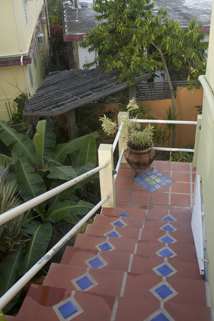
From our terrace we could see sunrise and sunset, and the waters and sky of the Caribbean which lapped the shore just a block away on the Malecon.
Turned out our landlord and lady were from our
own state of New York, where they do landscape design in the summer and spend
the winters in paradise, i.e. Vieques.
They live on the ground level of the house, and release the prime real
estate – the second floor with the view – to the renters. Anthony is a Master Gardener, and Eileen an
artist and landscape designer, and they grow a wonderful tropical garden in the
alleyway alongside and another pocket garden back of the house. Delicious
bananas from the trees were a bonus treat every day. Eileen and Carlos did the painting above right.
It depicts the original house. Carlos built on the second floor, which
took three years. He is now working on the roof to make it a sitting
and barbecue area.
 |
 |
 |
| Lobster's claw - Heliconia humilis |
Orchid - Epidendrum |
Parrot's beak - Heliconia psittacorum |
Without a car, we checked out just about every other mode of transportation – walking, biking, horse-back riding, kayaking.
Our first day we just walked around and scoped out our new environment. Down to the Malecon
- the little strip is the walkway along Esperanza Beach. They redid that walkway for $950,000 according to the sign. Vendors line the walk on the weekends. Steve bought maracas made from a gourd. Workers were continuing improvements, planting shrubs in the planters and working on a plaque while we were there. and on the other side are restaurants and various shops, and a little blue house.
 |
 |
 |
| View from Malecon to Puerto Rico |
House across from Malecon |
Statue on Malecon |
Chickens run around the streets, as do the dogs and horses, but some are fenced in. That's the next door to ours.
Boats are docked out on the Puerto Real. Walked along Puerto Real (below left) and over a spit of land which goes out to Cayo Tierra; past some guys
camping, and we were at Sun Bay, or Ensenada Sombe (below right) , as it's known on the
old USGS topo map. Already we had an amazing beach practically to
ourselves.
We were there at a breezy time; the surf was rough, and the red flag was out (above left) indicating swimming conditions were dangerous. Puerto Rican flag at Sun Bay offices (above right).
We just played in the shallow waters and enjoyed the sun.
A brief shower sent us under coconut and mangrove trees.
In the afternoon, we waded through the shallow rocks across to Cayo Tierra. Don't you love Tevas? Did a little beachcombing and then checked out the trails around the little island.
We had arranged with Gary at
Vieques Adventure Company to rent bikes for the next two days. The morning when he was supposed to deliver the bikes, I woke up early and saw the sun rise, and all was peaceful. But soon the eastern skies, from whence the weather generally comes, were dense with dark clouds and it started raining. I didn't have internet the whole week, so couldn't check out the radar to see whether this weather was likely to be persistent or not. If I had been there a few more days, or had yet heard from one of the Fun Brothers that when it rains this time of year, it'll be over in an hour, I might have been more optimistic. But we were afraid we were socked in for a rainy day. Unfortunately Gary told me he could not predict the weather and we cancelled the reservation out of an excess of caution.
Of course the sun came out in another hour, and I tried to rearrange with Gary, but he was then too busy and recommended
Blackbeard Sports as an alternative.
We arranged that rental for the next day, and headed down to the Malecon to see about kayaking. Yesterday we had seen a couple women in a kayak and they recommended the
Fun Brothers, so we headed to their stand on the east end of Calle Flamboyan a little past where the Malecon ends, and Jay Jay from Brooklyn set us up right away with a double kayak - $25 for two hours. We were hoping to do a lot of kayaking and head south to Playa Grande, but they discouraged us from heading with the wind at first as it could be very hard to get back as the wind continued to pick up in the afternoon. It was good we took their advice and headed instead east into the wind towards SunBay.
We got out of the kayak and pulled the boat over the spit and then hit the rough waters of Sonbe. There was no pause for a sip of water or to scratch as we crossed the bay in total concentration not to get side-swiped by the waves. Adrenaline was up! As we approached the other side of the bay, the waters calmed and we relaxed on the beach and ate our lunch in joy. Only two people walked by, and we had seen them both the day before. There we were on that far beach.
When we got back from kayaking we heard the electricity was out on the island (that happened twice while were there, but only lasted a couple hours). I had a message from
Blackbeard Sports that they wanted to deliver the bikes early, like this afternoon for no extra charge, since it was for their convenience. What a great deal! Thanks Diane! We were already getting free delivery to our place in Esperanza, since we booked it a day in advance, even though they're located in Isabel.
So that afternoon we rode the bikes past Sun Bay into the dirt roads over to Media Luna and Navio Beaches. Tucked into a small protected bay, Media Luna had quieter waters out of the wind and was a peaceful change.
We then rode over to Mosquito Bay to check it out, but it was daytime, so no bioluminescence. We might be the only tourists to the island who stayed more than a week and didn't make it to a biobay tour at night when bioluminesence was shining. We heard so many "glowing" accounts that we were afraid it might be anti-climactic. Actually we're not big on tours. We only had nine days – couldn't do everything… Just excuses – next time I hope we check it out.
 |
| sliver of Mosquito Bay beyond Sun Bay |
The next day we rode the bikes to Playa Grande -- west out of Esperanza on Route 997 past gardens and haciendas, slowing down for horses. All the cars we encountered on the narrow roads were courteous and shared the road with us. We turned left on 201 and very soon was a sign for the turn-off down a dirt road to Playa Negra, but Steve didn't want to check it out. In a couple miles we found the dirt road turn-off to Playa Grande. Before we turned down it, we checked out an open field surrounded by barbed wire and warning signs – it had been a site for underground bunkers and storage for when the Navy was there. I was almost going to take a picture of this forbidding area, but a sign said, "no fotografia" and warned that video cameras were watching our every move. We headed down the dirt road to the beach.
Playa Grande was empty and gorgeous with rocks and sand. My camera battery decided to conk out then. I forgot to see it coming. We walked around and relaxed and watched the surf crash against the rocks seeing only one young family while we were there.
We were thinking of checking out the road north after that, but 201 north was blocked off with a pile of dirt, so we decided to forget about trying to exploring more in that direction.
Wild horses wander the island – left behind by the Spanish explorers.
Many are Paso Fino horses or mixed blood. Like the wandering dogs and chickens, many, but not all, are owned by people but
allowed to roam free. We just had to do a trail ride to get to ride horses and find the trails. It was a splurge but worth it for the $70/person cash only for a two-hour tour. The trail ride with
Esperanza Riding Company took us on trails through thick vegetation over some hills with different views of the island. I was lucky to be on the back end of the group, so I got to get a lot out of one of our guides, Darcy. She was a South Carolina beach girl, who fell in love with the Caribbean over her honeymoon and convinced her husband to move there. Vieques was the least developed place they could find. Yes, there are lots of problems there, but when you get frustrated, you just go to the beach, and remember why you moved there. They are working to make a home there, carving out some jungle to plant a garden. She pointed out and shared with me some of the edible plants along our route – little apples that looked like crabapples, but were sweeter (it might be a jujube). She also grabbed little orange fruit with little stubs on it. She told me to open it up and chomp on the red seeds inside that tasted like chocolate-covered espresso beans. They really almost did. She didn't know what it was called, and my landlady didn't recognize it from my description. Now that I'm searching the web I think it could be
Momordica balsamina. From a distant hill, they pointed out the coconut trees lining Playa Cocal, and later we winded through a narrow jungly trail to ride along that beach, as we headed back to the stables.
Later that afternoon, when the electricity went out again, we took the bikes over to Playa Cocal, Coconut Beach. When we told Eileen about going there, she swore us to secrecy as to its location, as she said that beach is known to locals only.
We got the mountain bikes from
Blackbeard Sports again the next day. Steve liked to space out the biking, as those dirt roads down to the beaches are rough! The rental bikes are mountain bikes and for good reason. It was fun dodging around and through bumps and troughs, gravel and branches. If you don't have a bike you have to have a jeep to go on those roads. I got used to standing up on my feet on the pedals on the rough spots to avoid the constant bombardment to the bottom.
This time we headed east to the eastern beaches. First we stopped at the Stonehenge of Vieques. Darcy from the trail ride had tipped us off as to its location – just ¼ mile north of the Sun Bay beach entrance on 997, on the left. There was a big sign that said "Sitio Arqueológico Hombre de Puerto Ferro". Dating back to the Taino Indians, it's an eerie collection of large boulders, where they had also unearthed a 4000-year old skeleton.
We pedaled on to the turn-off to the eastern beaches. It's good we had packed sandwiches and hadn't planned to eat at the acclaimed Sol Food shack, as the sign said it was closed Monday through Thursday. On the north side of the Roosevelt Road was more barbed wire as there was the old Naval Station and now the center of the clean-up operation which is the largest employer on the island. At the entrance to the road were signs of the protests that had led finally to the closure of the naval base in 2003.
We took a dirt road – this one was closed off to motor vehicles -- down to Garcia Playuela – another beach on a quiet bay we thought we had to ourselves, but a couple appeared at the other end.
From there we could see the beach umbrellas on Playa Caracas, or Red Beach. We later rode over to check that one out. It's one of the few with paved road access. There were more people there, so it was less attractive to us.
The bridge to Bahiva La Chiva, Blue Beach, was out so we could not go there. Apparently there are still munitions in the water that need to be cleaned up. Steve was sore by then and we headed back.
On our last day, we went back to Jay Jay at the Fun Brothers as we wanted to do a two-hour guided snorkeling trip, since we hadn't really ever gone snorkeling. It was $35 apiece for two hours. Juan, a native Viequense, took us on, showing us how to clean the masks and make sure they fit. Then we got into one kayak and followed him in another out to Cayo Afuera, a small island across the bay where the snorkeling was good and we saw an amazing world of colorful fish and plants amid coral reefs. Juan wasn't too good about identifying what we were seeing, but he was fun, and determined to teach us to dive to the bottom, where we could see dozens of conch shells, with our life jackets on and retrieve a conch shell. Naturally the life jackets made that difficult, but he could do it easily and we both tried many times. I managed it once. But we had no room in our luggage to be able to bring home one of those conch shells. But we collected some little specimens beachcombing.
what we ate – We were also in the minority of tourists not to got out to eat at restaurants but one time. Steve does not like to go to restaurants, and insisted that we could save a lot of money. We only ate out once. Our first full day there we had lunch at
Duffy's which is across from the Malecon. The sandwiches were good washed down with
Medalla Light beer (the beer of Puerto Rico), and I learned that pan de agua was the best local bread. There we heard about
Chez Shack in Pilon, in the interior of the island, which is also owned by Hugh Duffy. We were going to break our restaurant fast one more time for the barbecue and steel drum music that they have on Monday nights. We were hoping to go, but when I called for a reservation, the guy said that he was cancelling it this week because there just weren't enough people on the island, and it costs him $1000.
I got the sense from people that Vieques is like a neglected step-child of Puerto Rico. The ferry service from the mainland has been spotty and unreliable over the years, and it's not just inconvenient for people, but for cargo, and thus the imports are slow and irregular in coming, and there's not a lot of farming on Vieques. There is a fresh market near Isabel on Tuesday's and we could have probably gotten a publico to go over there, or hitchhiked – we heard it's very safe. But Tuesday was toward the end of our stay and there was too much else to do.
For the rest of the time, we bought all our groceries from the two local stores:
Colmada Lydia and Tienda Verde (aka The Green Store).
 |

|
At the Tienda Verde we got fresh-baked pan de agua every other morning to use for our sandwiches. It was never ready until 11 am or so, and we often got it still warm from the oven. There is a bakery next to Colmada Lydia called La Dulce Esperanza, but they only bake Pan Sobao for bread, which has sugar and butter in it. Pan de agua is more like French - made only with yeast, flour, water and salt. Most days we packed a lunch – sandwiches with meat and cheese, lettuce and onions, mayonnaise and salsa. Dinners were mostly burritos – rice and beans, and a variety of other things. There was little selection of fresh vegetables in the stores – only onions, cubanelle style peppers, garlic, potatoes, and iceberg lettuce; but a good collection of canned and jarred mostly Goya products. Got frozen chicken once. The chicken went into the burritos, and then I cooked down the bones and skin to make a broth for the next day, just like I do at home. The next day skimmed off the fat and it made a great base for soup. Made one mistake with food, but at least I had a conversation with the clerk in spanish. I found unmarked packages of fish in the cooler and asked him what kind of fish it was. Bacalao. He told me it has
espinas, y tiene que quitarlas. He pointed out the another package of pollock, which was actually cheaper and he said the
espinas ya se habian eliminado. But that package was labelled salted pollock, and I was concerned about the saltiness. He said
tiene que lavarlos antes de cocinar. So I happily bought them and cleaned off the salt and loosely followed the recipe on the back but with not so many potatoes as there were enough there to feed at least 6 people. I figured we could get a couple meals out of the fish combining with rice and beans and vegetables… But even with the potatoes and tomato sauce, and then the rice and beans I added, it was awfully salty. We had two meals with too much salt. I'm glad Steve's blood pressure didn't burst a vein. I only put in small spoonful into another meal or two, as it was tasty. But had to throw out a bunch of it at the end.
I enjoyed the challenge of cooking with limited supplies, and our space at Casa Almendro was oh so relaxing in the evenings. Our sandwiches on beaches were divine… Steve really got to like iceberg lettuce and so did i. but I would have liked to have had one good dinner at El Quenepo.
Otra vez..
We never did need to use the publicos – the collective cabs. We took a taxi from the airport and back. We met Kate, one of the owners of
El Quenepo restaurant, on the little Cape Air plane we took from San Juan. She agreed we could ride together in a taxi to Esperanza, just a few miles from the airport on the northside to the southside of the island. She was delighted when Mario appeared with his cab, and we piled in. He was the original owner of El Quenepo, and she and her husband had bought it from him just a few years ago. At 78 years old, now he makes a living driving a cab around. He said in his younger days he the best horse-tamers on the island. He was great company pointing out many things on our drive with traditional music on the radio, and so we called him up for the return trip too. 787 741-8541 or 787 603-4946